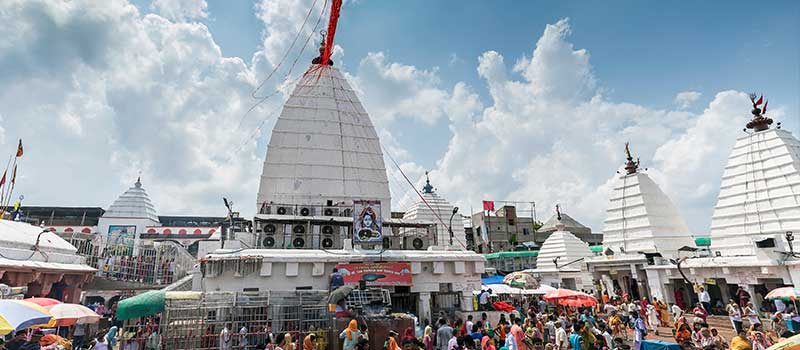
Overview of Vaidyanath Jyotirlinga
Baba Baidyanath Dham or Vaidyanath Jyotirlinga is one of the twelve holy Jyotirlingas of Lord Shiva. It is situated in Deoghar, Jharkhand. This temple is, most crucially, one of the most significant pilgrimage centers in India. Devotees arrive here to get blessings all over the country. The temple has become famous due to its healing abilities, divine power, and spiritual significance.
Vaidyanath is also known as the lord of Physicians. In other words, Lord Shiva is venerated as the highest healer here. Individuals travel to this sacred site in order to seek good health, happiness, and deliverance. It has therefore been transformed into a powerful place of hope and faith for many.
The temple complex contains a number of small shrines in the names of various gods and goddesses. In addition, the principal Jyotirlinga is served by ritual and daily offerings. In the month of Shravan (July-August), we find lakhs of devotees taking the holy water of the Ganga River in Sultanganj inside the temple. This water is offered in the Jyotirlinga by walking more than 100 kilometers, barefoot. This ritual is referred to as the Kanwar Yatra, and this is one of the most significant religious events in India.
Above all, visiting Vaidyanath Jyotirlinga is said to be equal to the visit of the twelve Jyotirlingas at the same time. The chants, prayers, and divine atmosphere here provide peace and strength for all the devotees. Put simply, there is no spiritual importance like in this temple.
History of Vaidyanath Jyotirlinga
The history of Vaidyanath Jyotirlinga is closely intertwined with devotion and faith. Ravana, the king of Lanka, was a big worshiper of Lord Shiva according to ancient scriptures. He had the most ardent prayers, and he exhorted Shiva to accompany him to Lanka. His devotion caused Lord Shiva to present him with a Jyotilinga. But he informed Ravana that the Lingam must never be put on the ground before it comes to Lanka.
At the same time, the deities were concerned that once Ravana got the Jyotirlinga to Lanka, he would be immortal. So, they planned to stop him. In the journey, Ravana was compelled to do his daily prayers. He temporarily gave the Lingam to a dairy boy (Lord Vishnu in disguise). At Deoghar, the boy laid the Lingam on the ground. Thus, it got rooted in that place.
This Lingam is present-day venerated as the Vaidyanath Jyotirlinga. The other legend is that Lord Rama performed some worship services for Shiva at this place when he traveled to Lanka. Consequently, the temple was further significant in Hindu practices.
The temple is ancient, was constructed hundreds of years ago, and has been preserved by numerous rulers and believers. A high stone spire is present in the temple complex. It is approximately 72 feet tall, and it has twenty-two additional temples around it. The architecture depicts the competence and dedication of ancient architects.
Most importantly, Vaidyanath Jyotirlinga is not merely a mythology component, but it is also a living temple that still influences millions. Its history reveals the zeal, the power of God, and the significance of faith in our daily lives.